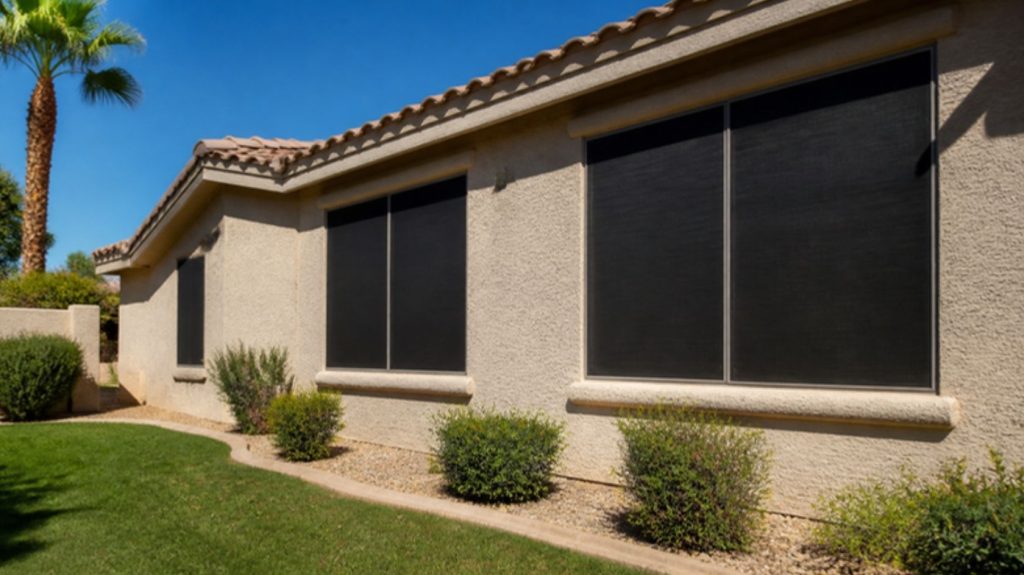
Solar screens are a tight, dark mesh mounted on the outside of a window that stops a large share of the sun’s heat before it reaches the glass. The screen maker Phifer rates its SunTex fabrics to block 80 to 90 percent of the sun’s heat and glare, and you can still see out through them.
If your west windows turn a room into an oven every afternoon, a solar screen is one of the cheapest fixes you can make without replacing the window. At TurnKey Window we look at the window, the screen and the exposure together, so you know whether a screen solves the problem or only hides a bigger one.
If you’d like someone to look at your hot rooms in person, send us a message or call (504) 226-6201, and read on for how the screens work, what they cost and where they earn their keep.
Key takeaways
- Solar screens work best mounted outside the glass, where they catch the sun before it becomes heat inside the room.
- Mesh is sold by how much heat and glare it blocks. An 80 percent screen keeps more view and airflow, and a 90 percent screen blocks more heat.
- East and west windows gain the most, because low morning and afternoon sun hits them straight on.
- HomeGuide puts exterior solar screens at $50 to $150 per window installed.
- They aren’t a fit for outward swinging casement or awning windows when mounted on the exterior.
What a solar screen is and how it differs from a bug screen
A standard insect screen is a light, open mesh built to let air in and keep bugs out. It does very little about heat. A solar screen uses a heavier, tighter weave designed to absorb and reflect sunlight while still letting you see outside.
Phifer describes its SunTex 80 and 90 fabrics as vinyl coated polyester that is pet resistant and resists mildew and fading. Phifer sells SunTex 80 and 90 as insect solar screens, so on an operable window they can replace the bug screen rather than sit on top of it.

How the mesh stops heat
Sunlight that passes through window glass turns into heat once it hits your floor, furniture and walls. A screen outside the glass intercepts that light first, so much of the energy is absorbed by the mesh and released outdoors.
That is why location matters so much. The Efficient Window Coverings program lists a shading coefficient of 0.14 to 0.33 for exterior solar screens and 0.50 to 0.70 for interior ones, where a lower number means less heat gets in.
Openness factor, explained
Openness factor is the share of the fabric that is open space. More openness means more view and more breeze, and less heat blocked.
Phifer lists SunTex 80 at about 25 percent openness and SunTex 90 at about 10 percent. For UV, it lists about 75 percent blockage for the 80 fabric and about 90 percent for the 90 fabric.
Picking a density for each window
You don’t have to put the same screen on every window. Matching the mesh to the exposure gets you heat control where it matters and a clearer view where it doesn’t.
| Mesh | Heat and glare blocked (maker rating) | Openness | Where it fits |
|---|---|---|---|
| SunTex 80 | About 80 percent | About 25 percent | North and east windows, rooms where you want the view and airflow |
| SunTex 90 | About 90 percent | About 10 percent | West and south windows with hard afternoon sun |
| SunTex 95, 97, 99 | About 95, 97 or 99 percent of UV | About 5, 3 or 1 percent | Exterior roller shades, awnings, porches and privacy screens, where privacy matters more than view |
HomeGuide’s cost guide gives the same practical advice: an 80 percent screen works well in most cases, and a 90 percent screen is best for south or west facing windows.
Color changes what you see
The Efficient Window Coverings guide notes that darker screen colors give the best mix of heat and glare reduction with visibility. Dark mesh is easier to see through from inside, the same way a dark window tint reads clearer than a light one.
Lighter colors like beige or stucco blend with a light house, but you’ll notice the screen more when you look out. If the view matters, pick dark.
Which windows to screen first
The Building America Solution Center, a Department of Energy resource, says unshaded east and west windows can take in as much as twice the solar heat per square foot as unshaded south windows. Its advice for summer shading is to handle skylights first, then east and west windows.
It also notes that in hot, low latitude areas in the far south, shading east and west surfaces well is the top priority. That describes south Louisiana well, so start with the east and west sides of the house.
- West windows. They take the long, low afternoon sun during the hottest part of the day.
- East windows. Morning sun hits them straight on, heating bedrooms and kitchens early.
- South windows without an overhang. A properly sized roof eave shades these in summer, so check what you already have before screening them.
- North windows. Usually last, since they get little direct sun.
What solar screens cost
HomeGuide’s cost guide puts exterior solar window screens at $50 to $150 per window installed. It says these fixed panels block 65 to 90 percent of the sun’s heat, and the higher percentages cost more.
- Custom made, framed screens: HomeGuide lists $50 to $90 per window at 80 percent density and $60 to $180 per window at 90 percent.
- Screen fabric by the roll: $2 to $8 per linear foot, depending on width and density.
- Frame kits for DIY: $10 to $20 per window for the spline, frame, corners and clips.
- Labor: installers charge $40 to $100 per hour on average, and some waive the fee on larger orders.
- Odd shapes: arched or unusually shaped windows cost $20 or more above a standard window.
HomeGuide also notes that installation prices run higher in late spring and summer, and some areas offer rebates for professionally installed solar screens. Check with your utility before you buy.
The trade-offs to know before you buy
Solar screens are simple, but they aren’t free of downsides. The Efficient Window Coverings guide lists a few worth weighing.
- Less view and light. Fixed panels reduce clarity, and rooms will feel dimmer on cloudy days.
- Same shade all day, all year. A fixed panel can’t tell noon from dusk or July from January.
- Winter gain is lost. In cooler months the screen also blocks the sun you’d like to have. The guide suggests taking screens down to regain that warmth in heating climates, and HomeGuide notes you can leave them up or store them for winter.
- Window style limits. Exterior screens aren’t appropriate for outward swinging windows, so casements and awnings need a different approach.
If a room is still hot with a solar screen in place, the glass itself may be the weak point. Our guide to energy efficient windows for homes covers low solar heat gain glass, which works on every window style and never blocks the view.
Fixed panels vs roller solar screens
Most homes use fixed panels that clip into the window frame like a regular screen. Roller solar screens mount above the window and roll down when you want shade.
The Building America Solution Center notes that exterior roller screens can be lifted when the sun isn’t on the window and lowered when it is, which keeps the view the rest of the day. The Efficient Window Coverings guide lists costs from around $45 for a DIY fixed panel to about $500 for a motorized roller on a standard window.
How to tell which you need
- Pick fixed panels for hard sun windows you rarely look out of, like a west bedroom or a garage.
- Pick rollers for a living room or view window where you want shade only a few hours a day.
- Check the frame first. A fixed panel needs a solid screen channel or clips to hold it tight.
The denser SunTex 95, 97 and 99 fabrics are a different product. Phifer says they’re engineered for exterior roller shades, awnings, porches and privacy screens, so you’ll usually see them on a patio rather than clipped into a window frame.
Installing and caring for solar screens
Fixed panels on ground floor windows are a reasonable DIY project if you measure carefully. Measure each opening, since older homes rarely have two windows exactly alike.
Check that the finished panel sits snug on all four sides. A gap at the top or bottom lets sun and insects through, and a loose panel will rattle in a storm.
Second story windows are a different job. Working from a ladder while handling a large, wind catching screen is where people get hurt, so hand upper floor installs to a professional with the right equipment.
Care is light. Phifer says its SunTex fabric needs only an occasional cleaning with mild soap and water, and the mesh carries a 10 year exterior warranty from the maker.
Frequently asked questions
Do solar screens really lower indoor heat?
Yes, when they’re mounted outside. Phifer rates its SunTex 80 and 90 mesh to block 80 to 90 percent of the sun’s heat and glare, and exterior screens stop that heat before it passes through the glass.
Can you see out through solar screens?
You can, though the view is softer and dimmer than through clear glass. Dark colors and lower density mesh like an 80 percent screen give the clearest view from inside.
How much do solar screens cost per window?
HomeGuide’s cost guide puts exterior solar screens at $50 to $150 per window installed, with 90 percent density and odd shaped windows at the higher end.
Should solar screens go on the inside or outside?
Outside, for heat control. Efficient Window Coverings lists a shading coefficient of 0.14 to 0.33 for exterior solar screens and 0.50 to 0.70 for interior ones, so the exterior version lets far less heat through.
Are solar screens worth it on north facing windows?
Usually not. North windows get little direct sun, so the money does more on west and east windows, which the Building America Solution Center says can take in about twice the solar heat of south windows.
Keep the heat outside this summer
Solar screens are a practical first step for hot rooms, and they work best when the window behind them is sound. If a screen is torn, sagging or the wrong size, our window screen repair and replacement service covers custom sizes for older openings.
If you can’t tell whether the screen or the window is the problem, contact TurnKey Window for a free consultation, or call (504) 226-6201.
Related reading
Sources
- Phifer: SunTex 80/90 exterior solar screens
- Efficient Window Coverings: Exterior solar screens
- Building America Solution Center: Shading and solar control for windows and skylights
- Building America Solution Center: Window attachments for solar control and energy efficiency
- Phifer: SunTex 95/97/99 exterior shading fabric
- HomeGuide: Solar screens cost